Skip to content
Menu

7 Carbon Steel Mesh Buying Tips for Global Buyers

Carbon Steel Mesh may look simple on a product sheet, yet small specification differences can affect fit, strength, and service life. Wire diameter, opening size, sheet or roll dimensions, and edge finish all matter. A mesh with a 25-millimeter opening behaves differently from one with a 10-millimeter opening, even when both use similar wire. Start with the job it must perform. Screening, fencing, reinforcement, and machine guards each call for different characteristics. Details matter.

For global buyers, clear specifications also reduce avoidable delays. Confirm the steel grade, dimensional tolerances, surface treatment, packaging, and required inspection documents with the supplier. Ask how measurements are checked, and request a sample when a close fit is important. A photograph can help, but it cannot confirm wire diameter. Not quite enough. Compare quotes on the same specifications, including coating, quantity, and delivery terms, rather than choosing by price alone. Check that rolls or panels will suit your handling and installation equipment. Salt air, moisture, and outdoor exposure may influence whether untreated or coated mesh is appropriate. No single choice fits every project. Supplier claims deserve practical questions, and even a careful checklist can miss a detail. The seven tips below offer a grounded way to compare options, clarify expectations, and make a more informed purchasing decision.
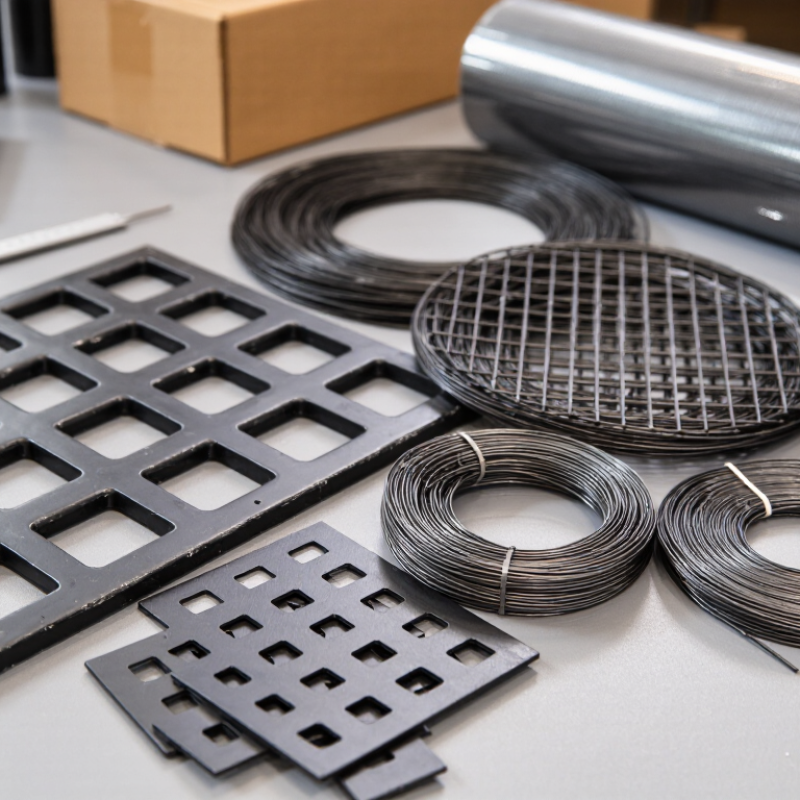
7 Carbon Steel Mesh Buying Tips for Global Buyers

Define the Application, Environment, and Performance Requirements

Before requesting carbon steel mesh quotations, define what the mesh must do. A screen separating coarse aggregate needs different openings from a guard panel or filter. Record the material being handled, expected particle size, flow rate, and whether the mesh will carry weight. Specify wire diameter and opening size together; either measurement alone can give buyers an incomplete picture. Small details matter.

Describe the installation environment clearly. Indoor, dry storage differs from a washdown area, coastal site, or space exposed to chemicals. Note moisture, cleaning agents, salt spray, temperature changes, and contact with other metals. These conditions affect corrosion risk and coating choices. Galvanizing may help in some settings, but it is not a universal solution. I would avoid promising service life without site conditions and maintenance details.

Translate performance needs into checks a supplier can verify. Ask for opening and wire-diameter tolerances, weld consistency, flatness, and any required load or tensile data. For a heavy panel, describe its support spacing and expected load rather than saying only “strong mesh.” Request a sample and measure several openings across it; one measurement can miss variation. Test the actual fit, too. Procurement specifications are sometimes imperfect, so record assumptions and resolve them before production.

Select the Steel Grade, Wire Diameter, and Mesh Opening

Carbon steel mesh performance depends on matching grade, wire diameter, and opening to the job. A low-carbon grade is generally easier to form and weld; higher-carbon steel can offer greater hardness but may be less forgiving during fabrication. Specify the grade standard, coating, and required mechanical properties, not just “carbon steel.” The World Steel Association’s World Steel in Figures 2024 reports 1,888.2 million tonnes of crude steel production in 2023. That scale makes clear material identification important, but it does not replace a batch test certificate.

Tip: Define the opening as the clear space between wires. For square mesh, a 2 mm wire with a 10 mm clear opening has a 12 mm pitch and about 69% open area. This estimate assumes regular spacing; welded intersections and production tolerances can change the result. Choose the opening for the particles you need to retain or the flow you need to maintain. Then select a wire diameter that can withstand the expected load without blocking too much area.

Before ordering, request a drawing that states grade, wire diameter, clear opening, tolerance, and coating. ISO 9044:2016 provides technical terms and tolerance guidance for industrial woven wire cloth; welded mesh may need a different product specification. Check a physical sample with calipers, too. It is easy to overlook tolerance details, and I would not assume two suppliers interpret “10 mm mesh” the same way.

Compare Surface Treatments, Coatings, and Fabrication Quality

For carbon steel mesh, the surface treatment should match its working environment. Indoor panels may need only a light protective finish, while outdoor mesh faces rain, condensation, and handling damage. Hot-dip galvanizing usually provides a thicker zinc layer than electro-galvanizing, but coating weight and coverage still vary. Ask suppliers for coating specifications and inspection records, not just the word “galvanized.” Small details matter.

Paint or polymer coatings can add color and another barrier, yet they may chip where wires cross or edges are cut. Check whether the mesh is coated before or after welding. Post-fabrication coating can cover weld zones more completely, though the process and finish should be confirmed for each order. A sample exposed to your actual cleaning or storage conditions may reveal issues that a product sheet misses.

Fabrication quality deserves the same attention as the coating. Measure wire diameter and opening size at several points, and inspect welds for gaps, sharp projections, or uneven joints. Confirm that sheets lie flat and that cut edges are clean. Tolerances can differ between suppliers, so state acceptable limits on the purchase drawing. I would not assume a neat-looking sample guarantees every batch will match; request batch inspection details and review them against received goods.

Verify Supplier Credentials, Product Testing, and Documentation

Before ordering carbon steel mesh, confirm the supplier’s registered business identity, production address, and actual manufacturing scope. A trading office may not control wire drawing, welding, or coating. Ask for a recent factory audit and verify that the certificate names the production site and product category. Paperwork alone is insufficient.

Request lot-specific mill test certificates and match heat numbers to the mesh bundle labels. Check wire diameter, aperture size, tensile properties, weld integrity, and coating mass when galvanized mesh is specified. Reports should identify the sampling method, test date, equipment, and acceptance criteria. For critical applications, use an independent laboratory accredited to ISO/IEC 17025. Small details matter: a 100 mm opening should be measured across several spaces, not one convenient spot.

The World Steel Association’s World Steel in Figures 2024 reports global crude steel production of 1,892.2 million tonnes in 2023. That scale makes clear traceability valuable, though the figure does not verify any mesh supplier. Keep the trail intact. Compare sample results with the purchase specification, then retain approved drawings, certificates, and inspection records against the shipment. A document can look complete yet omit the tested lot; that gap deserves a follow-up, not an assumption.

7 Carbon Steel Mesh Buying Tips for Global Buyers – Verify Supplier Credentials, Product Testing, and Documentation

Buying Tip What to Verify Useful Evidence Practical Buyer Check
1. Verify supplier credentials Confirm the supplier’s legal identity, registered address, production or trading role, and the scope and validity of any quality-management certification claimed. Business registration details; current certificate showing its scope and validity; independently verifiable contact and facility information. Check certificate details with the issuing certification body or its verification service. A quality-management certificate does not by itself certify a particular mesh product.
2. Define the mesh specification State the mesh type, opening size, wire diameter, sheet or roll dimensions, material grade, edge condition, and any required dimensional tolerances. Approved technical drawing or purchase specification; quotation and order that reference the same revision. Specify whether opening size is measured center-to-center or as a clear opening, and identify the measurement method and acceptance limits before production.
3. Check material identity and traceability Confirm the agreed steel grade and ensure material records can be linked to the supplied production lot or heat where applicable. Mill test certificate or material test report listing the grade and reported chemical and mechanical properties; lot or heat identification records. Match grade designations and reported values to the purchase specification. Request clarification if the certificate, product labels, and order use different identifiers.
4. Review product testing and inspection Check that test methods, sampling, acceptance criteria, and reporting match the mesh type and the agreed specification. Inspection and test plan; dated test report with sample identification, results, methods, and acceptance criteria. For welded mesh, agree how weld integrity will be assessed; for woven mesh, agree how weave and opening consistency will be inspected. Do not assume one test method applies to every mesh product.
5. Specify coating requirements If the mesh is galvanized or otherwise coated, identify the coating type, required coverage, and any agreed coating mass or thickness criteria. Coating test report and product specification. ASTM A90/A90M is one example of a method for determining the mass of zinc or zinc-alloy coating on iron or steel articles, where applicable. Confirm the cited method and acceptance limits are suitable for the product and purchase contract. A coating test result should identify the tested sample or lot.
6. Agree inspection and acceptance before shipment Set the inspection stage, sampling plan, defect definitions, permitted variation, and process for handling nonconforming goods. Signed specification; agreed inspection plan; pre-shipment inspection report when required; records of corrective actions for reported defects. Consider independent inspection for high-value or critical orders. Agree who selects samples and which documented criteria determine acceptance.
7. Confirm documentation and shipping details Check that product, quantity, packaging, origin, and shipment information are consistent across the order and export documents. Commercial invoice; packing list; transport document; certificate of origin or other required documents where applicable; product and inspection records. Before dispatch, compare document descriptions and quantities with the purchase order and packing labels. Confirm destination-country import and marking requirements with the relevant authorities or broker.

Buyer note: Standards and documentation requirements depend on the mesh construction, intended use, contract, and destination market. Confirm the applicable edition and acceptance criteria with the supplier before placing the order.

Evaluate Total Cost, Shipping Terms, and After-Sales Support

A low price per tonne can hide expensive details. Compare the landed cost: mesh, cutting, packing, inland haulage, ocean freight, insurance, duties, and destination handling. Ask for a written breakdown, not a single “delivered” figure. Check whether the quote uses the same wire diameter, aperture, sheet size, and tolerance; small specification changes affect weight and usable yield. A clean quote can still mislead. Request a sample packing list and confirm bundle dimensions before booking, especially if containers have weight or space limits.

Shipping terms need practical scrutiny. Confirm the named port, who pays loading and terminal charges, and when risk transfers. UNCTAD’s Review of Maritime Transport 2024 describes sharp freight-rate increases amid route disruptions and longer voyages, making a dated freight quote important. Allow for possible schedule changes. worldsteel’s October 2024 Short Range Outlook estimated global steel demand at about 1.75 billion tonnes in 2024 and 1.77 billion in 2025; demand forecasts do not predict your mesh price, but they show why supply conditions can shift. For after-sales support, agree on inspection records, defect evidence, response times, and remedies before payment. Ask how claims work if mesh arrives bent or dimensions differ. A vague warranty is not support. Keep the requirements in writing, and be realistic: even a careful inspection may miss a problem inside a tightly packed bundle.

7 Carbon Steel Mesh Buying Tips for Global Buyers

Evaluate total cost, shipping terms, and after-sales support—not just the quoted price.

Illustrative buyer-priority scores on a 1–5 scale, not market statistics. Compare landed cost, confirm specifications and delivery terms, and agree on inspection and after-sales procedures before ordering.